Calc I — Midterm 1 Zero-to-Exam Review
0 · The 4-Year Warm-Up (arithmetic you forgot)
Skip this section if it feels obvious — but honestly, read it once. 90% of "I can't do calculus" is actually "my fractions and factoring are rusty." Calculus itself is only 3 new ideas. The rest is algebra you already learned once.
Fractions (the thing everyone forgot)
Add: need the same bottom. \(\frac{1}{3}+\frac{1}{4}=\frac{4}{12}+\frac{3}{12}=\frac{7}{12}\) — multiply top×(other bottom), don't touch until bottoms match.
Multiply: straight across. \(\frac{2}{3}\times\frac{5}{7}=\frac{10}{21}\)
Divide: flip the second one. \(\frac{2}{3}\div\frac{5}{7}=\frac{2}{3}\times\frac{7}{5}=\frac{14}{15}\)
Complex fraction (big one for limits!): \(\dfrac{\frac{a}{b}}{\frac{c}{d}}=\frac{a}{b}\times\frac{d}{c}=\frac{ad}{bc}\) — flip and multiply.
Exponent laws
| Rule | Example |
|---|---|
| \(x^a\cdot x^b=x^{a+b}\) | \(x^2\cdot x^5=x^7\) |
| \(\dfrac{x^a}{x^b}=x^{a-b}\) | \(\dfrac{x^7}{x^2}=x^5\) |
| \((x^a)^b=x^{ab}\) | \((x^2)^3=x^6\) |
| \(x^0=1\) | \(99^0=1\) |
| \(x^{-a}=\dfrac{1}{x^a}\) | \(x^{-3}=\frac{1}{x^3}\) |
| \(x^{1/n}=\sqrt[n]{x}\) | \(x^{1/2}=\sqrt{x}\), \(x^{3/2}=(\sqrt{x})^3\) |
Factoring (you WILL need this — limits lean on it hard)
1. Pull out the GCF first, always: \(3x^2+6x=3x(x+2)\)
2. Difference of squares: \(a^2-b^2=(a-b)(a+b)\). Example: \(x^2-9=(x-3)(x+3)\). This one is all over the midterm.
3. Trinomials \(x^2+bx+c\): find two numbers that multiply to \(c\), add to \(b\).
- \(x^2+5x+6\) → need ×6, +5 → 2 and 3 → \((x+2)(x+3)\)
- \(x^2-x-6\) → need ×(−6), +(−1) → −3 and +2 → \((x-3)(x+2)\)
- \(x^2-7x+12\) → ×12, +7... both negative → \((x-3)(x-4)\)
4. Difference of cubes (rare but they like it): \(a^3-b^3=(a-b)(a^2+ab+b^2)\)
Cube values to just know: \(8=2^3\), \(27=3^3\), \(64=4^3\), \(125=5^3\).
Sign rules + solving basics
Negative × negative = positive. Minus sign flips everything inside brackets: \(-(x-3)=-x+3\).
Solve \(\frac{x-1}{2}=3\) → multiply both sides by 2 → \(x-1=6\) → \(x=7\). Whatever you do to one side, do to the other. That's all "solving" ever is.
Function notation — read it out loud
\(f(x)=x^2+1\) just means "the machine named f eats input x and outputs \(x^2+1\)". So \(f(3)=3^2+1=10\), \(f(-2)=5\), \(f(x+h)=(x+h)^2+1=x^2+2xh+h^2+1\).
1 · Pre-Calc Essentials (1.1–1.5)
What's a function (1.1)
A function is a machine where every input gives exactly ONE output.
Vending machine analogy: press B4, you get chips. If pressing B4 sometimes gave chips and sometimes gave a soda — broken machine, not a function.
Vertical line test: if any vertical line hits the graph twice or more → NOT a function. (Two same x's mapping to different y's.)
Worked: is it a function?
(a) \(y=x^2\) — every x gives one y ✓ (but note both \(x=2\) and \(x=-2\) give 4 — that's allowed, it's one output per input, not one input per output)
(b) \(x=y^2\) — try \(x=4\): \(y=2\) or \(y=-2\). One input, two outputs ✗ NOT a function.
(c) The circle \(x^2+y^2=9\) — vertical line through the middle hits twice ✗.
Domain and range
Domain = every legal input. Range = every possible output.
Three things break domains. That's the whole topic:
- Dividing by zero — illegal. Block the x-values that make the bottom 0.
- Square roots of negatives — illegal (in real numbers). Need whatever's inside \(\ge 0\).
- Log of non-positives — \(\ln(x)\) needs \(x \gt 0\).
Worked: three domain examples
Example 1: \(f(x)=\dfrac{x+1}{x-2}\). Bottom zero at \(x=2\) → domain = all reals except 2. Written: \((-\infty,2)\cup(2,\infty)\) or "all \(x\neq 2\)".
Example 2: \(g(x)=\sqrt{x-5}\). Need \(x-5\ge0\) → \(x\ge 5\) → domain \([5,\infty)\).
Example 3: \(h(x)=\dfrac{\sqrt{x+3}}{x-1}\). Two conditions: \(x+3\ge0\) → \(x\ge-3\), AND \(x\neq1\). Domain: \([-3,1)\cup(1,\infty)\). Note the \(-3\) is INCLUDED (square root allows zero) but 1 is excluded (division can't be zero).
Transforms (1.3) — the moving-graph rules
| Change | Effect on graph |
|---|---|
| \(f(x)+c\) | shift UP \(c\) |
| \(f(x)-c\) | shift DOWN \(c\) |
| \(f(x+c)\) | shift LEFT \(c\) (counterintuitive — the plus moves it left!) |
| \(f(x-c)\) | shift RIGHT \(c\) |
| \(c\,f(x)\) | vertical stretch by \(c\) (flip if \(c\lt0\)) |
| \(f(cx)\) | horizontal squeeze by \(\frac{1}{c}\) |
Memory trick: whatever is done to the x itself (inside) does the opposite of what it looks like, and acts horizontally. Whatever is done outside acts normally, vertically.
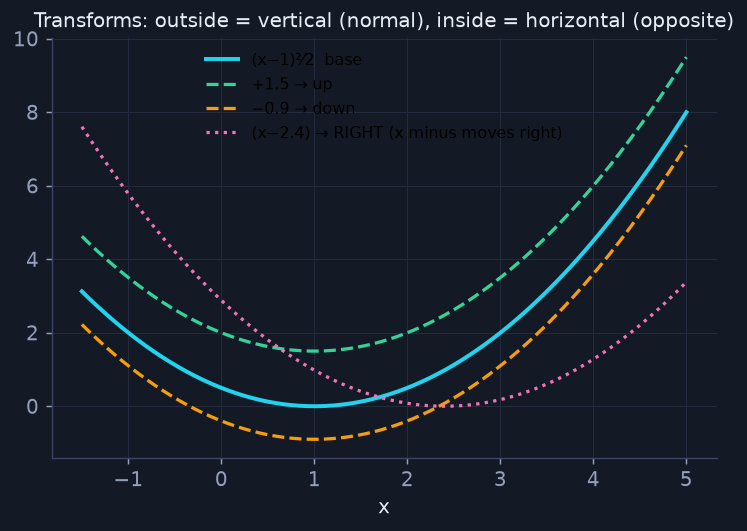
Worked: transforms
Example 1: The point \((2,6)\) is on \(f(x)=|x|\). Where does it land on \(f(x)=|4x|\)?
Inside change → horizontal, factor \(1/c=1/4\). x-coordinate gets divided by 4: new point \((\frac{2}{4},6)=(0.5,\,6)\). (This exact question style was on a past MC.)
Example 2: Describe \(g(x)=(x-3)^2+1\) from \(x^2\): shift right 3, up 1. Vertex moves from \((0,0)\) to \((3,1)\).
Example 3: \(h(x)=-2\sqrt{x}\): vertical stretch ×2 and flip upside down (the negative).
Inverse functions (1.5)
A function eats x, spits y. The inverse runs the machine backwards: eats y, spits x. To find it: swap x and y, solve for y.
Only machines that can run backwards have inverses (one-to-one functions — every output used only once). Horizontal line test.
Worked: inverse, step by step
Find the inverse of \(f(x)=\dfrac{2x+3}{x-1}\).
- Write \(y=\dfrac{2x+3}{x-1}\)
- Swap: \(x=\dfrac{2y+3}{y-1}\)
- Multiply both sides by \((y-1)\): \(x(y-1)=2y+3\)
- Expand: \(xy-x=2y+3\)
- Collect all y-terms on one side: \(xy-2y=x+3\)
- Factor the y out: \(y(x-2)=x+3\)
- Divide: \(y=\dfrac{x+3}{x-2}\)
So \(f^{-1}(x)=\dfrac{x+3}{x-2}\).
Verify (they love this as a T/F): \(f(f^{-1}(x))\) should equal \(x\): \(f\!\left(\frac{x+3}{x-2}\right)=\frac{2\frac{x+3}{x-2}+3}{\frac{x+3}{x-2}-1}=\frac{2(x+3)+3(x-2)}{x-2}=\frac{2x+6+3x-6}{x-2}=\frac{5x}{5}\)... hold on — let's recompute the bottom: \(\frac{x+3}{x-2}-1=\frac{x+3-(x-2)}{x-2}=\frac{5}{x-2}\). Top: \(\frac{2(x+3)}{x-2}+3=\frac{2x+6+3x-6}{x-2}=\frac{5x}{x-2}\). Ratio \(=\frac{5x/(x-2)}{5/(x-2)}=x\) ✓ Verified.
Worked: inverse of exponential/log
Example: \(f(x)=e^{2x}\). Inverse: swap → \(x=e^{2y}\) → \(\ln x = 2y\) → \(y=\frac{\ln x}{2}\). So \(f^{-1}(x)=\frac{\ln x}{2}\), domain \(x\gt0\).
Log laws that matter:
- \(\ln(ab)=\ln a+\ln b\)
- \(\ln\frac{a}{b}=\ln a-\ln b\)
- \(\ln(a^k)=k\ln a\)
- \(e^{\ln x}=x\) and \(\ln(e^x)=x\) — they undo each other
Mini-drill 1 (try before opening)
a) Domain of \(f(x)=\dfrac{\sqrt{x}}{x-4}\)?
b) \((5,2)\) is on \(f(x)=\sqrt{x}\). Where does it go on \(f(3x)\)?
c) Find \(f^{-1}\) for \(f(x)=\dfrac{x-1}{3x+2}\)
d) Solve: \(\ln(x)+\ln(x-3)=\ln 10\) (hint: combine laws first)
Answers: a) \(x\ge0\) AND \(x\neq4\) → \([0,4)\cup(4,\infty)\) · b) x gets squeezed by ⅓ → \((5/3, 2)\) · c) \(y=\frac{x-1}{3x+2}\) → \(x(3y+2)=y-1\) → \(y(3x-1)=-1-x\) → \(f^{-1}(x)=\frac{-x-1}{3x-1}\) · d) \(\ln(x(x-3))=\ln10\) → \(x^2-3x=10\) → \(x^2-3x-10=0\) → \((x-5)(x+2)=0\) → \(x=5\) (reject −2, logs need positive) → x=5
2 · What a Limit Actually Is (2.1–2.2) — the heart of this exam
The idea, zero math
A limit asks: "as x sneaks up on this number, what value does the function head toward?"
Key twist that confuses everyone at first: the limit does not care what happens AT the point. It's about the approach. The function can have a hole, a bomb, whatever — AT the point — and the limit only looks at the neighborhood.
Speedometer analogy: your speed at the exact instant you enter the tunnel is unknowable (the clock reading is broken at that instant — "undefined point"), but everyone agrees you were going ~80 going in. The limit is the ~80.
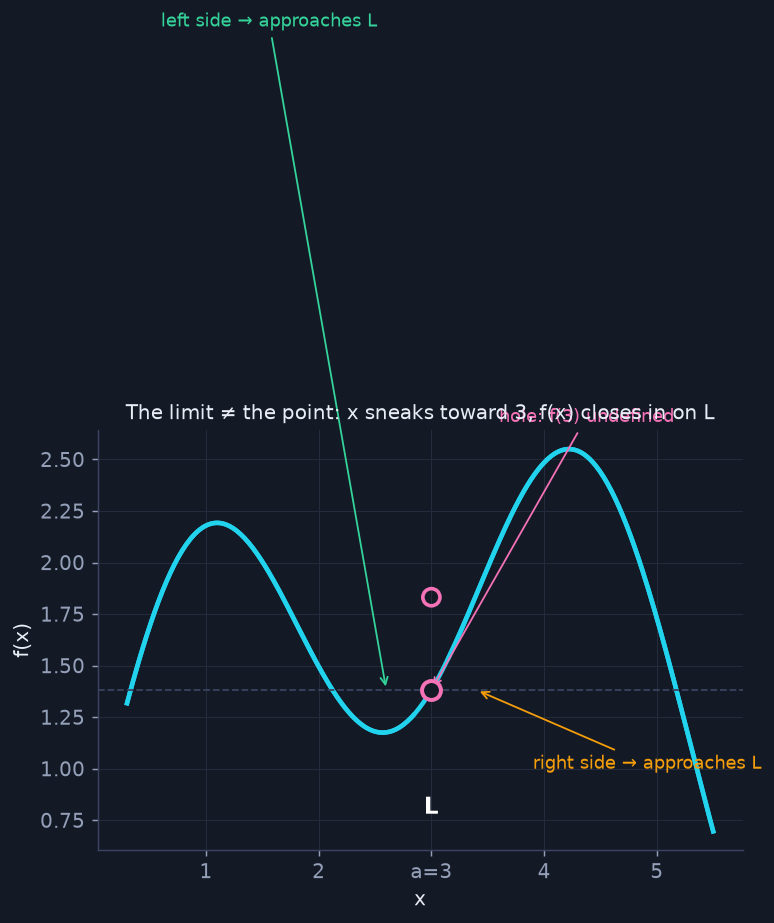
The formal statement
$$\lim_{x\to a}f(x)=L \quad\text{means: } f(x) \text{ can be made as close to } L \text{ as we want, by taking } x \text{ close enough to } a \text{ (but } x\neq a\text{).}$$
One-sided limits — LEFT and RIGHT
\(\displaystyle\lim_{x\to a^-}f(x)\) = approach from numbers smaller than \(a\) (from the left on the number line).
\(\displaystyle\lim_{x\to a^+}f(x)\) = approach from numbers bigger than \(a\).
The limit exists ⟺ both sides agree:
$$\lim_{x\to a}f(x)=L \iff \lim_{x\to a^-}f(x)=\lim_{x\to a^+}f(x)=L$$
If left ≠ right → the limit Does Not Exist (DNE). This single line decides half the T/F questions on midterms.
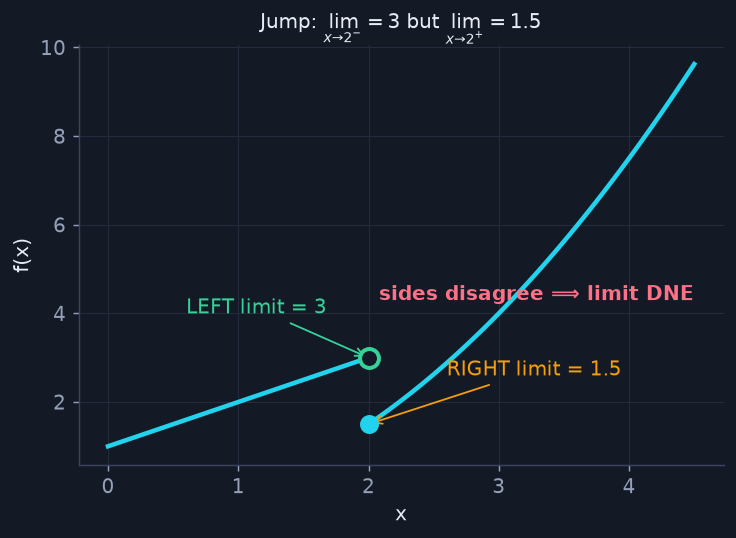
Worked: piecewise (both sides)
\(f(x)=\begin{cases}x+2 & x\lt 2\\ x^2 & x\ge 2\end{cases}\). Find \(\displaystyle\lim_{x\to 2}f(x)\).
- LEFT side uses the top piece (x<2): \(\lim_{x\to 2^-}(x+2)=2+2=4\)
- RIGHT side uses the bottom piece (x≥2): \(\lim_{x\to 2^+}(x^2)=4\)
- 4 = 4 → the two-sided limit exists: \(\lim_{x\to2}f(x)=\boxed{4}\)
- Note: \(f(2)=2^2=4\) here too, so \(f\) is actually continuous at 2 (more in section 4).
Worked: one side breaks → DNE
\(f(x)=\begin{cases}x+2 & x\lt 2\\ x^2+3 & x\ge 2\end{cases}\). Left: 4. Right: \(4+3=7\). \(4\neq7\) → jump → \(\lim_{x\to2}f(x)\) DNE. (Each one-sided limit exists fine — the two-sided one doesn't.)
The #1 exam pattern: 0/0 → factor → cancel → retry
When direct substitution gives \(\frac{0}{0}\), that number is FORBIDDEN but the limit still usually exists. Factor the top, kill the culprit, retry:
$$\lim_{x\to 3}\frac{x^2-9}{x-3}=\lim_{x\to 3}\frac{(x-3)(x+3)}{x-3}=\lim_{x\to 3}(x+3)=\boxed{6}$$
Why cancelling is legal here: in the limit we only evaluate at \(x\neq3\), where \(\frac{x-3}{x-3}=1\) honestly. We never divide actual zero by actual zero.
Worked: the conjugate trick (square roots)
$$\lim_{x\to 0}\frac{\sqrt{x+9}-3}{x}$$
Plug 0: \(\frac{3-3}{0}=\frac{0}{0}\). Can't factor a root, so multiply top AND bottom by the conjugate of the top \((\sqrt{x+9}+3)\):
- \(\frac{\sqrt{x+9}-3}{x}\cdot\frac{\sqrt{x+9}+3}{\sqrt{x+9}+3}\)
- Top: \((\sqrt{x+9})^2-3^2=(x+9)-9=x\) (difference of squares!)
- \(=\dfrac{x}{x(\sqrt{x+9}+3)}=\dfrac{1}{\sqrt{x+9}+3}\) (cancel the x)
- Plug 0: \(\dfrac{1}{3+3}=\boxed{\dfrac16}\)
Worked: cube version (Stewart Example)
$$\lim_{x\to 2}\frac{x^3-8}{x-2}=\lim_{x\to 2}\frac{(x-2)(x^2+2x+4)}{x-2}=\lim_{x\to2}(x^2+2x+4)=4+4+4=\boxed{12}$$
Remember \(a^3-b^3=(a-b)(a^2+ab+b^2)\) from the warm-up? Told you factoring was the real skill.
When a limit does NOT exist — the 3 ways
- Jump: left ≠ right (piecewise example above)
- Blow-up: \(\lim_{x\to0}\frac1x\) — from the right it runs to \(+\infty\), from the left to \(-\infty\) → DNE (infinity is not a number "reached")
- Oscillation: \(\lim_{x\to0}\sin\frac1x\) wiggles between −1 and 1 faster and faster, never settles → DNE
Mini-drill 2
a) \(\displaystyle\lim_{x\to5}\frac{x^2-25}{x-5}\) b) \(\displaystyle\lim_{x\to1}\frac{x^2+3x-4}{x-1}\) c) \(\displaystyle\lim_{x\to0}\frac{\sqrt{x+16}-4}{x}\) d) \(\displaystyle\lim_{t\to2}\frac{t^3-8}{t^2-4}\)
Answers: a) \((x-5)(x+5)/(x-5)\) → 10 · b) factor: \((x+4)(x-1)/(x-1)\) → 7 · c) conjugate → \(1/8\) · d) \(\frac{(t-2)(t^2+2t+4)}{(t-2)(t+2)}=\frac{t^2+2t+4}{t+2}\Big|_{t=2}=\frac{12}{4}=3\)
3 · Limit Laws (2.3) — your main toolbelt
The 7 laws (memorize the NAMES — T/F loves asking which law justifies a step)
Suppose \(\lim f(x)=L\) and \(\lim g(x)=M\) both exist. Then:
| # | Law | Says |
|---|---|---|
| 1 | Sum | \(\lim[f+g]=L+M\) |
| 2 | Difference | \(\lim[f-g]=L-M\) |
| 3 | Constant Multiple | \(\lim[c\,f]=cL\) |
| 4 | Product | \(\lim[f\cdot g]=L\cdot M\) |
| 5 | Quotient | \(\lim\frac{f}{g}=\frac{L}{M}\), if \(M\neq0\) |
| 6 | Power | \(\lim[f^n]=L^n\) |
| 7 | Root | \(\lim\sqrt[n]{f}=\sqrt[n]{L}\) (if odd n, any L; if even, L≥0) |
Plus the two basic ones: \(\lim_{x\to a}c=c\) and \(\lim_{x\to a}x=a\).
The actual strategy (what they really test)
- Try direct substitution first. Always. If you get a normal number — done. Most limits are this easy.
- Got \(\frac{0}{0}\)? → indeterminate → factor & cancel, or conjugate, or (later) L'Hôpital.
- Got \(\frac{c}{0}\) where \(c\neq0\)? → the limit is a blow-up → DNE (or ±∞ one-sided). Do NOT say the answer is 0 or ∞ carelessly.
Worked: direct substitution via the laws
$$\lim_{x\to2}\frac{x^3-2x+4}{x-1}$$
Bottom at 2: \(2-1=1\neq0\) → Quotient law is legal → evaluate top and bottom at 2: \(\frac{8-4+4}{1}=\boxed{8}\). One line, but you should NAME the legality: denominator ≠ 0 at 2.
Worked: a sneaky one — multiply out instead of factor
$$\lim_{x\to0}\frac{(3+x)^{-1}-(3)^{-1}}{x}=\lim_{x\to0}\frac{\frac{1}{x+3}-\frac13}{x}$$
0/0 again. Combine the top into ONE fraction: \(\frac{1}{x+3}-\frac13=\frac{3-(x+3)}{3(x+3)}=\frac{-x}{3(x+3)}\)
Then divide by x: \(\frac{-x}{3(x+3)}\cdot\frac1x = \frac{-1}{3(x+3)}\) → plug 0 → \(\boxed{-\frac19}\)
This is a real Stewart example. Pattern: complex fractions → combine to one fraction → cancel.
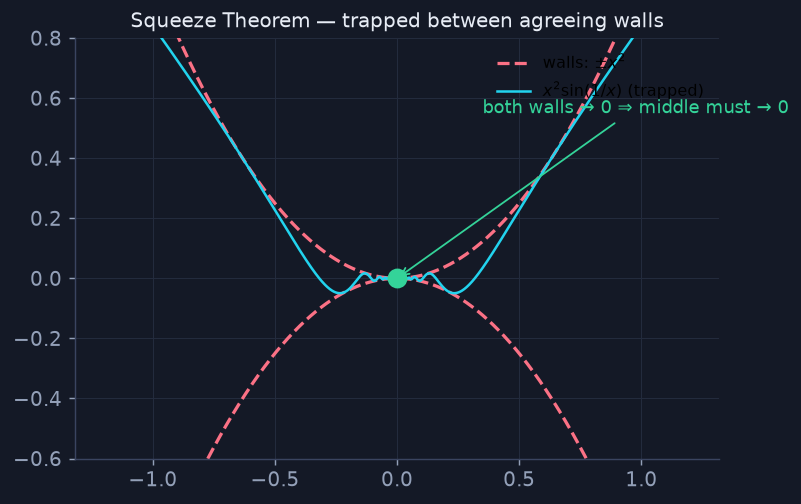
Squeeze Theorem (2.3 end)
If a function is trapped between two others that agree at the target, the middle one must agree too:
$$g(x)\le f(x)\le h(x) \text{ near } a, \quad \lim_{x\to a}g=\lim_{x\to a}h=L \;\Rightarrow\; \lim_{x\to a}f=L$$
Worked classic: \(\lim_{x\to0}x^2\sin\frac1x\). The sine part wiggles between −1 and 1 forever, so:
\(-x^2\le x^2\sin\frac1x\le x^2\). Both walls go to 0. So the trapped middle → \(\boxed{0}\).
You will see this on a practice quiz or midterm — it's the prof's favorite "weird one."
Mini-drill 3
a) \(\displaystyle\lim_{x\to1}\frac{x^2-1}{x^2-3x+2}\) b) \(\displaystyle\lim_{x\to4}\frac{\sqrt{x}-2}{x-4}\) c) \(\displaystyle\lim_{x\to0}(\sqrt{x^4+9}-3)\sin\frac1x\)
Answers: a) \(\frac{(x-1)(x+1)}{(x-1)(x-2)}=\frac{x+1}{x-2}\Big|_1=-2\) · b) conjugate: \(\frac{x-4}{(x-4)(\sqrt{x}+2)}=\frac{1}{\sqrt{x}+2}\Big|_4=1/4\) · c) \(\sqrt{x^4+9}\to3\) so walls: \(-(\ldots)\le\ldots\le(\ldots)\) both → 0 → squeeze → 0? careful: amplitude → \(3-3=0\) → answer 0.
4 · Continuity (2.5) — matches the corrected Question 2(b)!
What "continuous" means in English
You can draw the graph without lifting your pen. No holes, no jumps, no teleports.
Formal version — \(f\) is continuous at \(a\) iff all three hold:
- \(f(a)\) exists (point is actually there — no hole)
- \(\displaystyle\lim_{x\to a}f(x)\) exists (both sides agree — no jump)
- They're equal: \(\lim_{x\to a}f(x)=f(a)\) (the point is where it should be)
The three questions in order: "Is there a point? Do neighbors agree? Is the point where the neighbors say?" Fail ANY one → discontinuous.
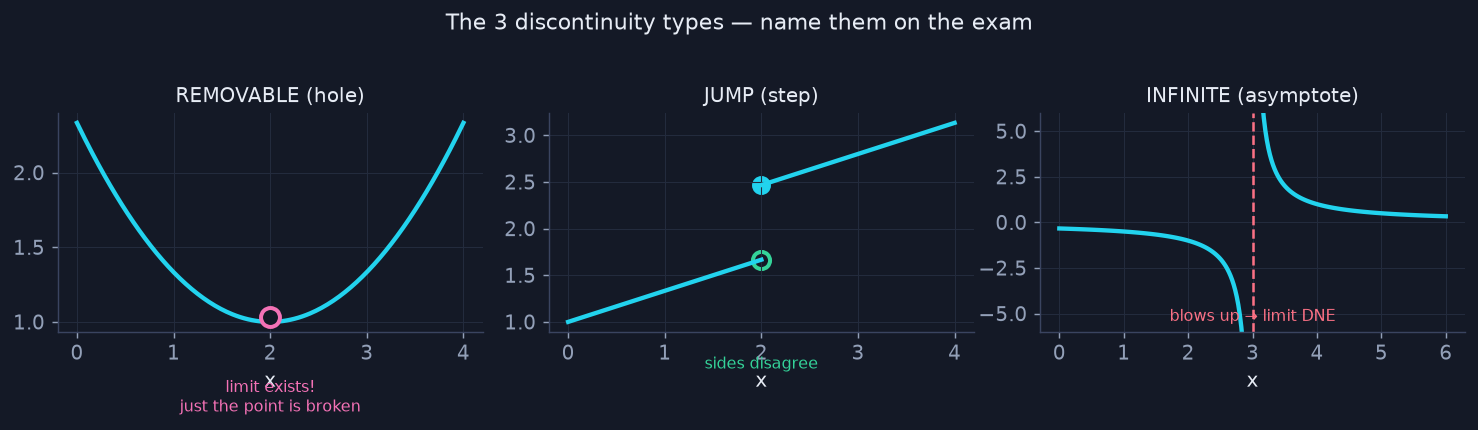
The 3 break types (know the names)
| Type | What it looks like | Which check fails |
|---|---|---|
| Removable | hole; limit exists but \(f(a)\) missing or misplaced | #1 or #3, but #2 fine |
| Jump | step; sides disagree | #2 (limit DNE) |
| Infinite | vertical asymptote, e.g. \(1/x\) at 0 | #2 (limit DNE) |
Removable = "fixable by filling/adjusting ONE point." Jump and infinite are not fixable.
Worked: find k making it continuous (THE exam question)
$$f(x)=\begin{cases}\dfrac{x^2-4}{x-2} & x\neq2\\ k & x=2\end{cases} \quad\text{— find } k \text{ so } f \text{ is continuous everywhere.}$$
- For \(x\neq2\): rational with no zero-bottom issues except at 2 → continuous there automatically.
- Only question: at \(x=2\). Limit: \(\displaystyle\lim_{x\to2}\frac{x^2-4}{x-2}=\lim\frac{(x-2)(x+2)}{x-2}=4\)
- Need \(f(2)=k\) to equal the limit → \(\boxed{k=4}\)
That's it. Limit exists (4), point exists (k), set them equal. Every "find k for continuity" problem is this recipe.
Worked: classify the break
\(g(x)=\begin{cases}x^2 & x\lt1\\ 3-x & x\ge1\end{cases}\). Continuous everywhere?
- Both pieces are polynomials → continuous on their own territories.
- At \(x=1\): left limit \(=1^2=1\); right limit \(=3-1=2\).
- \(1\neq2\) → two-sided limit DNE → jump discontinuity at \(x=1\) — not removable.
Worked: the "continuous EXCEPT at" wording (directly from the corrected Q2b)
Say the practice file says: "\(f(x)\) is continuous on its domain except at \(x=-2\), where it is not continuous." What's being tested? You should be able to explain WHY it fails there — which of the 3 conditions dies. If \(f(-2)\) doesn't exist → condition 1. If sides disagree at −2 → condition 2. If \(f(-2)\) exists but disagrees with the limit → condition 3. Read the graph/table they give you and name the failed condition.
Continuity facts worth memorizing
- Polynomials: continuous everywhere
- Rational functions \(\frac{p}{q}\): continuous everywhere except the zeros of \(q\)
- \(\sqrt{x}\): continuous on \([0,\infty)\)
- \(\sin,\cos\): continuous everywhere
- Sums/products of continuous functions: continuous. Quotients: continuous where bottom ≠ 0.
Common mistakes (prof said T/F needs JUSTIFICATION — use these)
Mini-drill 4
a) Find \(k\): \(f(x)=\begin{cases}kx+1 & x\le3\\ x^2 & x\gt3\end{cases}\) continuous everywhere.
b) True/False (justify!): "If \(f\) is continuous at \(a\), then \(\lim_{x\to a}f(x)\) exists."
c) Classify the discontinuity of \(f(x)=\frac{x+2}{x^2-x-6}\) at its bad point.
Answers: a) left at 3: \(3k+1\); right: 9. \(3k+1=9\) → \(k=8/3\) · b) TRUE — condition 2 of the checklist is built into continuity (that's the direction that works; the reverse is false) · c) factor: \((x+2)/[(x-3)(x+2)]\), bad points x=3 and x=−2. At −2: numerator also 0 → removable hole (limit \(=1/(-5)=-0.2\) exists). At 3: bottom zero, top ≠0 → infinite (vertical asymptote).
5 · The Precise Definition of a Limit — ε and δ (2.4) — LIGHT
What this is really saying (archery analogy)
"The limit is L" formally means: no matter how tiny a target zone (ε) you demand around L, I can give you a shooting zone (δ) around a such that every arrow shot from inside the δ-zone lands inside your ε-zone.
\(\varepsilon\) = YOUR demand (error tolerance on outputs). \(\delta\) = MY response (input accuracy). The statement: for every ε > 0, there EXISTS a δ > 0 such that: if \(0\lt|x-a|\lt\delta\) then \(|f(x)-L|\lt\varepsilon\).
Note the \(0\lt|x-a|\): we never shoot from exactly \(a\) itself — consistent with limits never caring about the point.
How a proof goes (template)
Claim: \(\lim_{x\to a}f(x)=L\). Given an arbitrary ε>0: Find δ (as a formula in ε) such that the implication holds. Usually: work backwards from \(|f(x)-L|\lt\varepsilon\), massage until you see \(|x-a|\lt\text{something}\).
Worked proof 1 (linear — the standard one)
Prove: \(\lim_{x\to3}(2x+1)=7\).
- Given ε>0. Want: \(|(2x+1)-7|\lt\varepsilon\).
- Simplify: \(|2x-6|=2|x-3|\)
- Need \(2|x-3|\lt\varepsilon\) ⟺ \(|x-3|\lt\varepsilon/2\)
- Choose \(\boxed{\delta=\varepsilon/2}\). Then \(0\lt|x-3|\lt\delta\) implies \(|2x+1-7|=2|x-3|\lt2\delta=\varepsilon\). ∎
Worked proof 2 (quadratic — needs the "cap δ" trick)
Prove: \(\lim_{x\to2}x^2=4\).
- Want: \(|x^2-4|=|x-2||x+2|\lt\varepsilon\)
- Problem: the \(|x+2|\) factor floats around. Cap it: if \(|x-2|\le1\), then x∈[1,3] so \(|x+2|\le5\).
- Then \(|x^2-4|\le5|x-2|\). Want ≤ ε ⟸ \(|x-2|\lt\varepsilon/5\).
- Choose \(\delta=\min\{1,\ \varepsilon/5\}\) (min = "whichever is smaller, so BOTH conditions hold"). ∎
The ε–δ lecture video the prof posted (Azar) walks exactly this shape. If a proof question appears, it will be linear like Proof 1 — quadratic if they're feeling mean.
Negation for T/F: "limit does NOT equal L" means: there EXISTS an ε>0 such that for EVERY δ>0, some x with \(0\lt|x-a|\lt\delta\) has \(|f(x)-L|\ge\varepsilon\). (Every vs exists flips.)
6 · Limits at Infinity & Horizontal Asymptotes (2.6)
The idea
Instead of x approaching a number, x marches off to \(+\infty\) or \(-\infty\). Question: where does \(f(x)\) SETTLE (if it settles)? The settling value, if any, is a horizontal asymptote.
"Biggest term wins." For huge x, the highest power in a polynomial is a bully — everything else is noise. \(\frac{100x^2+3x}{7x^2-900}\) is basically \(\frac{100x^2}{7x^2}=\frac{100}{7}\) when x is astronomic.
The degree table for rational functions \(\frac{p(x)}{q(x)}\)
| Compare degrees | \(\lim_{x\to\pm\infty}\) |
|---|---|
| deg(top) < deg(bottom) | 0 |
| deg(top) = deg(bottom) | ratio of leading coefficients |
| deg(top) > deg(bottom) | ±∞ → DNE (no horizontal asymptote) |
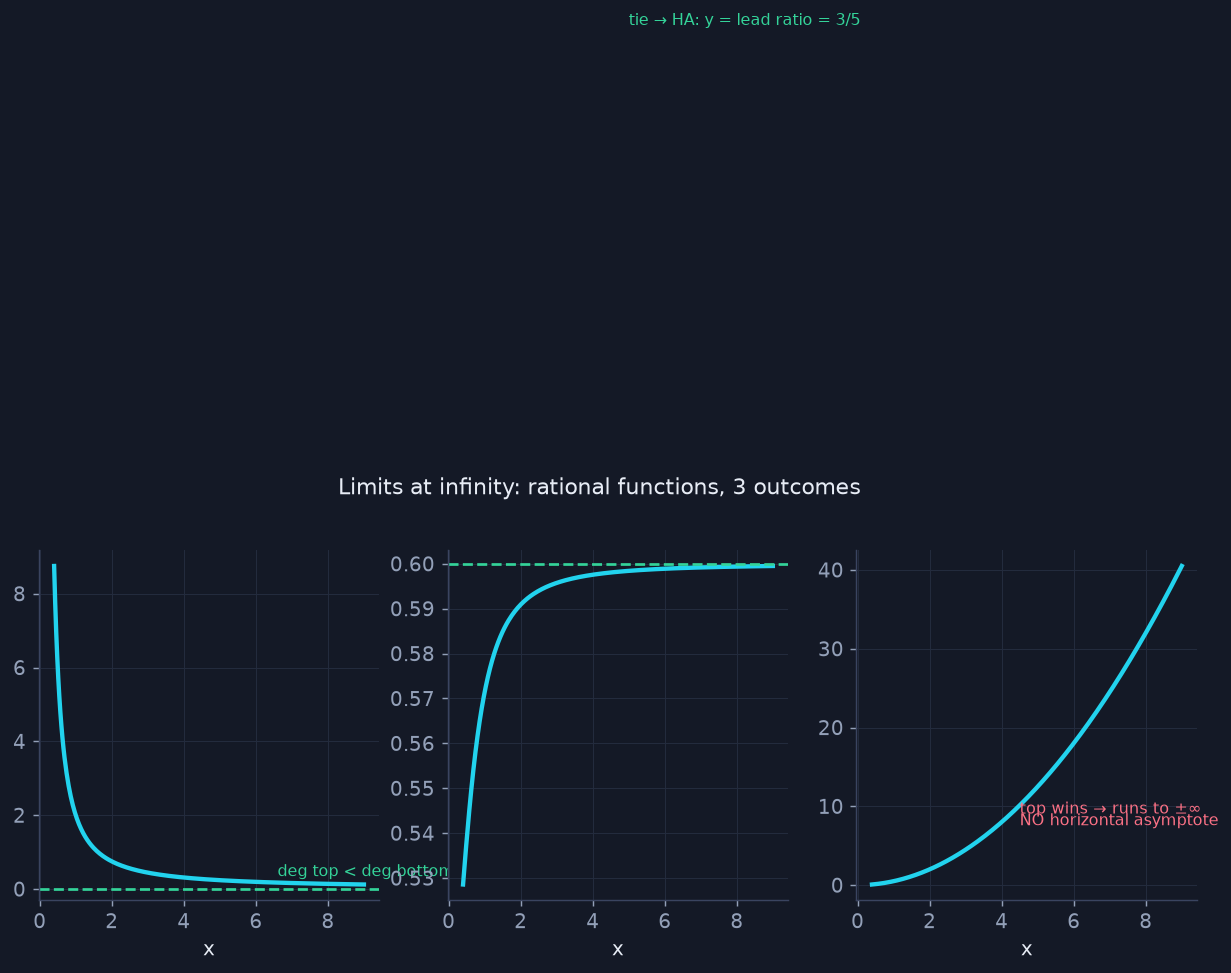
Worked: one of each
a) \(\displaystyle\lim_{x\to\infty}\frac{4x-1}{x^3+2}=\) top degree 1 < bottom degree 3 → \(\boxed{0}\)
b) \(\displaystyle\lim_{x\to\infty}\frac{3x^2-5x+1}{5x^2+x}=\) tie at degree 2 → \(\frac{3}{5}\)
c) \(\displaystyle\lim_{x\to\infty}\frac{x^2+1}{x-3}=\) top wins → grows like x → \(+\infty\) → DNE (no HA)
Worked: the divide-by-highest-power method (show the work!)
$$\lim_{x\to\infty}\frac{3x^2-5x+1}{5x^2+x}$$
- Divide every term, top and bottom, by \(x^2\): \(\dfrac{3-5/x+1/x^2}{5+1/x}\)
- As \(x\to\infty\): each \(\frac{1}{x}\) and \(\frac{1}{x^2}\) → 0 (limits at infinity of tiny-over-huge are 0)
- \(=\dfrac{3-0+0}{5+0}=\boxed{\dfrac35}\)
Write it this way on the exam — the table above is for speed-checking, the division is for marks.
Worked: root flavor
$$\lim_{x\to\infty}\frac{\sqrt{x^2+9}}{2x+3}$$
- \(\sqrt{x^2+9}=\sqrt{x^2(1+9/x^2)}=\sqrt{x^2}\cdot\sqrt{1+9/x^2}\). For \(x\to+\infty\), \(\sqrt{x^2}=x\) → \(=x\sqrt{1+9/x^2}\)
- \(\dfrac{x\sqrt{1+9/x^2}}{2x+3}=\dfrac{\sqrt{1+9/x^2}}{2+3/x}\to\dfrac{\sqrt{1+0}}{2}=\boxed{\dfrac12}\)
Careful: for \(x\to-\infty\), \(\sqrt{x^2}=\textbf{|x|}=-x\) — sign flips! This asymmetry is a classic trap.
Infinite limits at finite points (vertical asymptotes)
\(\displaystyle\lim_{x\to0^+}\frac1x=+\infty\), \(\displaystyle\lim_{x\to0^-}\frac1x=-\infty\) → two-sided DNE, vertical asymptote at 0.
\(\displaystyle\lim_{x\to3}\frac{1}{(x-3)^2}=+\infty\) from BOTH sides (square kills the sign) — we say the limit is \(+\infty\), and there's a VA at 3.
Saying "the limit equals infinity" is shorthand for "the function grows without bound" — not that ∞ is a number.
Mini-drill 6
a) \(\displaystyle\lim_{x\to\infty}\frac{7x^3-4x}{2x^3+9x^2}\) b) \(\displaystyle\lim_{x\to\infty}\frac{5x+2}{x^4-3}\) c) \(\displaystyle\lim_{x\to-2^+}\frac{x+5}{x+2}\)
Answers: a) tie at 3 → 7/2 · b) bottom wins → 0 · c) plug-ish: bottom → 0⁺ (x+2 slightly positive), top → 3 (positive) → \(+\infty\) (VA at −2)
7 · Intermediate Value Theorem (2.5's sequel)
The statement (memorize this wording)
If \(f\) is continuous on the closed interval \([a,b]\), and \(N\) is any number between \(f(a)\) and \(f(b)\) (inclusive), then there exists at least one \(c\) in \((a,b)\) with \(f(c)=N\).
Hiking analogy: you walked a continuous trail from elevation −2 m to +6 m. Every elevation between −2 and 6 — including exactly 0 m — got stepped on at some point. No teleporting, guaranteed.
The #1 use on exams: prove a root (zero) exists in an interval. Choose \(N=0\).
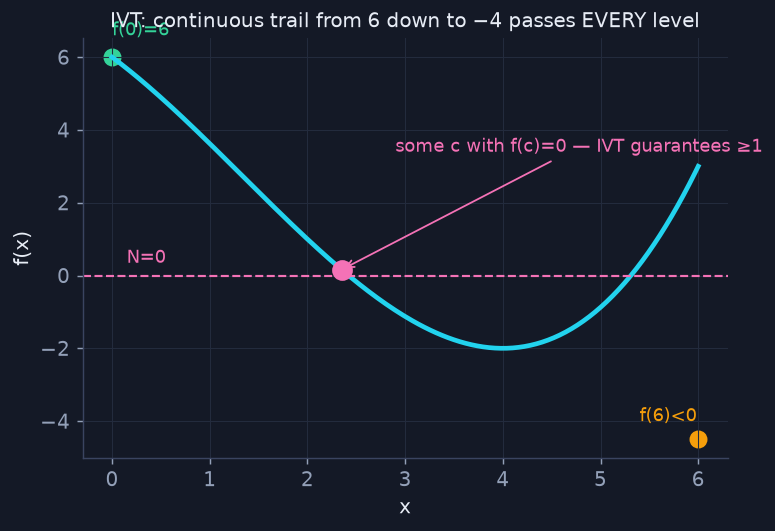
Worked: prove a root exists (the classic, verbatim format)
Show that \(x^3+x-4=0\) has a solution in \((1,2)\).
- Let \(f(x)=x^3+x-4\). It's a polynomial → continuous everywhere, in particular on \([1,2]\). (Say this — it's a mark.)
- Evaluate endpoints: \(f(1)=1+1-4=-2\) (negative); \(f(2)=8+2-4=6\) (positive)
- \(N=0\) is between \(-2\) and 6
- IVT ⇒ there exists \(c\in(1,2)\) with \(f(c)=0\), i.e., \(c^3+c-4=0\). ∎ A root exists in \((1,2)\).
They can also ask "how many times can it cross?" — that's IVT + a monotonicity argument, usually later material. For the midterm: existence is the ask.
What IVT does NOT say (T/F bait)
8 · The Derivative by Definition (2.7–2.8, 3.1) — guaranteed material
What a derivative IS (understand before memorizing)
Average speed: drove 100 km in 2 h → 50 km/h. \(\frac{\text{change in position}}{\text{change in time}}\)
Instantaneous speed: what the speedometer shows at one instant. You can't divide by "0 hours"... but you CAN take the average over a shrinking window: over the last 0.1s, last 0.01s, last 0.001s — watch what those averages approach. That approach-value IS the derivative.
Geometric: slope of the secant line through two points → shrink the gap → secant rotates into the tangent line → derivative = tangent slope.
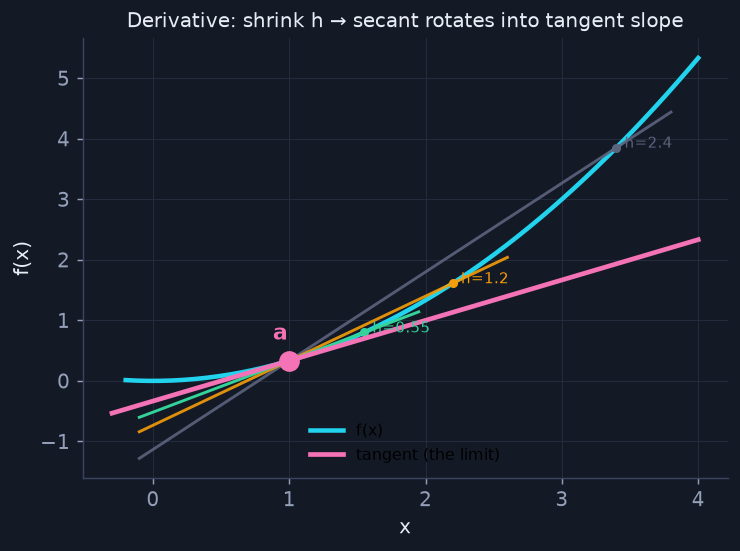
The two definition forms
$$f'(x)=\lim_{h\to0}\frac{f(x+h)-f(x)}{h} \qquad\qquad f'(a)=\lim_{x\to a}\frac{f(x)-f(a)}{x-a}$$
Same idea, two costumes. Use form 2 when they hand you a specific point \(a\). Leibniz notation: \(\frac{dy}{dx}\) — same thing.
Worked 1: quadratic from scratch (master this one cold)
\(f(x)=x^2+3x\). Find \(f'(x)\) using the definition (they will demand the definition, not the shortcut).
- Need \(f(x+h)\): replace every x with (x+h): \(f(x+h)=(x+h)^2+3(x+h)=x^2+2xh+h^2+3x+3h\)
- Difference: \(f(x+h)-f(x)=(x^2+2xh+h^2+3x+3h)-(x^2+3x)=2xh+h^2+3h\)
- Divide by h: \(\frac{h(2x+h+3)}{h}=2x+h+3\) for \(h\neq0\)
- Send \(h\to0\): \(\boxed{f'(x)=2x+3}\)
Step 1 is where everyone dies. Practice writing \((x+h)^2=x^2+2xh+h^2\) until automatic.
Worked 2: fraction flavor
\(f(x)=\dfrac1x\). Find \(f'(x)\) by definition.
- \(f(x+h)-f(x)=\frac1{x+h}-\frac1x=\frac{x-(x+h)}{x(x+h)}=\frac{-h}{x(x+h)}\)
- Divide by h: \(\frac{-h}{x(x+h)}\cdot\frac1h=-\frac{1}{x(x+h)}\)
- \(h\to0\): \(\boxed{f'(x)=-\frac{1}{x^2}}\)
Worked 3: root flavor (conjugate again!)
\(f(x)=\sqrt{x}\). Find \(f'(x)\) by definition.
- \(\frac{\sqrt{x+h}-\sqrt{x}}{h}\cdot\frac{\sqrt{x+h}+\sqrt{x}}{\sqrt{x+h}+\sqrt{x}}=\frac{(x+h)-x}{h(\sqrt{x+h}+\sqrt{x})}=\frac{h}{h(\sqrt{x+h}+\sqrt{x})}=\frac{1}{\sqrt{x+h}+\sqrt{x}}\)
- \(h\to0\): \(\boxed{f'(x)=\frac{1}{2\sqrt{x}}}\)
Spot the pattern — conjugate trick shows up in BOTH limits and derivatives. One trick, double duty.
Worked 4: tangent line equation (very common Q)
Find the tangent line to \(f(x)=x^2+3x\) at \(x=1\) (using our result \(f'(x)=2x+3\)).
- Point: \(f(1)=1+3=4\) → point \((1,4)\)
- Slope: \(f'(1)=2(1)+3=5\)
- Point-slope: \(y-4=5(x-1)\) → \(y=5x-1\)
Format: point (plug into f), slope (plug into f'), then \(y-y_1=m(x-x_1)\). Memorize that 3-beat.
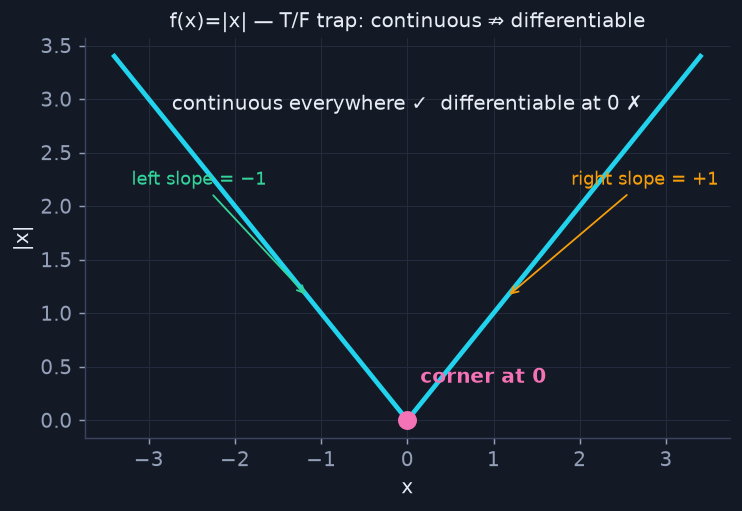
When f′(a) does NOT exist (T/F goldmine)
- Corner: \(|x|\) at 0 — left slope −1, right slope +1, limit DNE
- Cusp: like \(x^{2/3}\) at 0 — sides go ±∞
- Vertical tangent: slope infinite, e.g. \(\sqrt[3]{x}\) at 0
- Discontinuity: if f isn't even continuous at a, f′(a) is dead on arrival
2.8 quickies they toss in
Higher derivatives: \(f''(x)\) = derivative of the derivative (rate of change OF the rate — acceleration).
For \(f(x)=x^2+3x\): \(f'(x)=2x+3\), \(f''(x)=2\).
Mini-drill 8
a) Use the definition on \(f(x)=3x^2\).
b) Use the definition on \(f(x)=x^2-x\) at the point \(a=2\) (form 2).
c) Where is \(f(x)=|x-3|\) not differentiable, and why?
Answers: a) \(\frac{3(x+h)^2-3x^2}{h}=\frac{6xh+3h^2}{h}=6x+3h→\ \boxed{6x}\) · b) \(\frac{f(x)-f(2)}{x-2}=\frac{(x^2-x)-(2)}{x-2}=\frac{(x-2)(x+1)}{x-2}=x+1→\ f'(2)=3\) · c) corner at \(x=3\): left slope −1, right +1.
9 · Differentiation Rules (3.1–3.2) — the machinery
The rulebook
| Rule | Statement | Quick example |
|---|---|---|
| Power | \(\dfrac{d}{dx}x^n=n\,x^{n-1}\) | \((x^7)'=7x^6\), \((x)'=1\), \((\sqrt{x})'=\frac12x^{-1/2}\), \((1/x)'=-x^{-2}\) |
| Constant | \((c)'=0\) | \((5)'=0\) |
| Const·f | \((cf)'=cf'\) | \((3x^2)'=6x\) |
| Sum/Diff | \((f\pm g)'=f'\pm g'\) | \((x^2+x)'=2x+1\) |
| Product | \((fg)'=f'g+fg'\) | see below |
| Quotient | \(\left(\frac fg\right)'=\frac{f'g-fg'}{g^2}\) | see below |
Why power rule works (a one-line peek): \(\frac{d}{dx}x^n=\lim\frac{(x+h)^n-x^n}{h}\) → binomial expand → all terms keep factor h except \(nx^{n-1}h\) → divide, send h→0. You'd never write that on the midterm but knowing WHY makes it stick.
The \(\frac{d}{dx}e^x=e^x\) fact (3.1's headline): exponential is its own derivative. If it appears, that's the whole fact.
Worked: negative + fractional powers (where marks die)
a) \(f(x)=\dfrac{1}{x}\) — rewrite as \(x^{-1}\) → \(f'(x)=-x^{-2}=-\dfrac{1}{x^2}\) (matches the definition answer from section 8 — sanity check!)
b) \(f(x)=\sqrt{x}\) — rewrite as \(x^{1/2}\) → \(f'(x)=\frac12x^{-1/2}=\dfrac{1}{2\sqrt{x}}\) ✓
c) \(f(x)=\sqrt[3]{x^2}=x^{2/3}\) → \(f'(x)=\frac{2}{3}x^{-1/3}=\dfrac{2}{3\sqrt[3]{x}}\)
THE move: before anything else, rewrite every root and every 1/(...) into exponent form. Then differentiate. Then rewrite back pretty.
Worked: polynomials end-to-end
\(f(x)=x^5-4x^3+6x-\pi\)
\(f'(x)=5x^4-12x^2+6-0\) (π is a constant → derivative 0)
Worked: product rule ×2
a) \(f(x)=x^2\sin x\): \(f'g+fg'=(2x)(\sin x)+(x^2)(\cos x)=\boxed{2x\sin x+x^2\cos x}\)
b) \(f(x)=(x^2+1)(x^3-3x)\): two routes —
- Product rule: \((2x)(x^3-3x)+(x^2+1)(3x^2-3)=2x^4-6x^2+3x^4-3x^2+3x^2-3=5x^4-6x^2-3\)
- Expand first: \(x^5-x^3+3x^2-3\) → \(5x^4-3x^2+6x\)... careful — expand: \((x^2+1)(x^3-3x)=x^5-3x^3+x^3-3x=x^5-2x^3-3x\) → derivative \(5x^4-6x^2-3\) ✓ same. Good — cross-check your product rule with expansion whenever you can.
Worked: quotient rule ×2
a) \(y=\dfrac{x}{x^2+1}\): \(\dfrac{(1)(x^2+1)-(x)(2x)}{(x^2+1)^2}=\dfrac{1-x^2}{(1+x^2)^2}\)
b) \(y=\dfrac{x^2+2x}{x+1}\): \(\dfrac{(2x+2)(x+1)-(x^2+2x)(1)}{(x+1)^2}=\dfrac{2(x+1)^2-x^2-2x}{(x+1)^2}=\dfrac{2x^2+4x+2-x^2-2x}{(x+1)^2}=\dfrac{x^2+2x+2}{(x+1)^2}\)
Common mistakes
10 · Trig Derivatives (3.3) — pure memorization, no sheet allowed
The table (6 entries — this IS the memorization load)
| \((\sin x)'=\cos x\) | \((\cos x)'=-\sin x\) |
| \((\tan x)'=\sec^2 x\) | \((\cot x)'=-\csc^2 x\) |
| \((\sec x)'=\sec x\tan x\) | \((\csc x)'=-\csc x\cot x\) |
Pattern to remember it: every "co-" function (cos, cot, csc) has a negative derivative. Start from sin→cos and cos→−sin; the rest follow from quotient rule (below).
Trig facts you need backstage (warm-up 2.0)
\(\tan x=\frac{\sin x}{\cos x}\) · \(\sec x=\frac{1}{\cos x}\) · \(\csc x=\frac{1}{\sin x}\) · \(\cot x=\frac{\cos x}{\sin x}\)
\(\sin^2x+\cos^2x=1\) (everywhere the most-used identity)
Special values: \(\sin\frac{\pi}{6}=\frac12\), \(\sin\frac{\pi}{4}=\frac{\sqrt2}{2}\), \(\cos\frac{\pi}{3}=\frac12\), \(\tan\frac{\pi}{4}=1\)
Worked: proving the tan rule (this exact proof was a lecture video)
Derive \((\tan x)'=\sec^2x\) from sin/cos:
- \(\tan x=\dfrac{\sin x}{\cos x}\) → quotient rule: \(\dfrac{\cos x\cdot\cos x-\sin x\cdot(-\sin x)}{\cos^2x}\)
- \(=\dfrac{\cos^2x+\sin^2x}{\cos^2x}\)
- Numerator = 1 (identity!) → \(=\dfrac{1}{\cos^2x}=\sec^2x\) ∎
Worked: sec by quotient rule (prof's video example)
\(\sec x=(\cos x)^{-1}\)
- Quotient/power: \(y'=-(\cos x)^{-2}\cdot(-\sin x)=\dfrac{\sin x}{\cos^2x}\)
- \(=\dfrac{1}{\cos x}\cdot\dfrac{\sin x}{\cos x}=\sec x\tan x\) ∎
Worked: mixed differentiation
a) \(f(x)=3\sin x-4\cos x+2\tan x\) → \(f'(x)=3\cos x+4\sin x+2\sec^2x\)
b) \(f(x)=x\cos x\) (product!) → \(f'(x)=\cos x-x\sin x\)
c) \(f(x)=\dfrac{\sin x}{x}\) (quotient!) → \(f'(x)=\dfrac{x\cos x-\sin x\cdot1}{x^2}=\dfrac{x\cos x-\sin x}{x^2}\)
The limit-proof they filmed (sine from first principles)
\(\lim_{h\to0}\frac{\sin h}{h}=1\) and \(\lim_{h\to0}\frac{\cos h-1}{h}=0\) — these two facts + squeeze theorem are how Stewart proves \((\sin x)'=\cos x\). You won't redo the full proof, but if asked where \((\sin x)'=\cos x\) comes from: "two special limits + the definition."
4.6 — Graphing with calculus (the token content)
Sign of f′ tells the story: \(f'\gt0\) → increasing; \(f'\lt0\) → decreasing. \(f'\) changing + → − at a point → local MAX there; − → + → local MIN. They may ask you to verify a graph feature (intercept, asymptote, max spot) with calculus reasoning rather than eyeballing. Light, but know the sign logic.
Mini-drill 10
a) \(f(x)=x^2\tan x\) b) \(f(x)=\dfrac{\cos x}{x^2+1}\) c) \(f(x)=5x\sec x\)
Answers: a) \(2x\tan x+x^2\sec^2x\) · b) \(\frac{-\sin x(x^2+1)-\cos x(2x)}{(x^2+1)^2}=\frac{-(x^2+1)\sin x-2x\cos x}{(x^2+1)^2}\) · c) \(5\sec x+5x\sec x\tan x\)
11 · Chain Rule + Implicit Diff (3.4–3.5 territory) — bonus prep, flagged "maybe"
The midterm officially covers 3.1–3.3 (+4.6), but Lecture 8 notes include chain rule and implicit differentiation, so your prof may squeeze a taste in. Learn the pattern — it's 10 minutes.
Chain rule — the "outside-inside" idea
For compositions \(f(g(x))\): derivative of outside (keeping inside untouched) × derivative of inside.
$$\dfrac{dy}{dx}=\dfrac{dy}{du}\cdot\dfrac{du}{dx}$$
Gear analogy: two gears, outer and inner. Total spin = outer spin × inner spin.
Worked: chain ×3
a) \(\sin(3x)\): outside sin, inside 3x → \(\cos(3x)\cdot3=\boxed{3\cos(3x)}\)
b) \((x^2+1)^5\): outside (·)⁵, inside \(x^2+1\) → \(5(x^2+1)^4\cdot2x=\boxed{10x(x^2+1)^4}\)
c) \(\sqrt{x^2+4}\): outside √ → \( (x^2+4)^{1/2}\) → \(\frac12(x^2+4)^{-1/2}\cdot2x=\boxed{\dfrac{x}{\sqrt{x^2+4}}}\)
Implicit differentiation — when y is trapped inside
When you can't isolate y (e.g. \(x^2+y^2=25\)), differentiate BOTH sides with respect to x — and every time you touch a y-term, multiply by \(\frac{dy}{dx}\) (chain rule reflex). Then solve for \(\frac{dy}{dx}\).
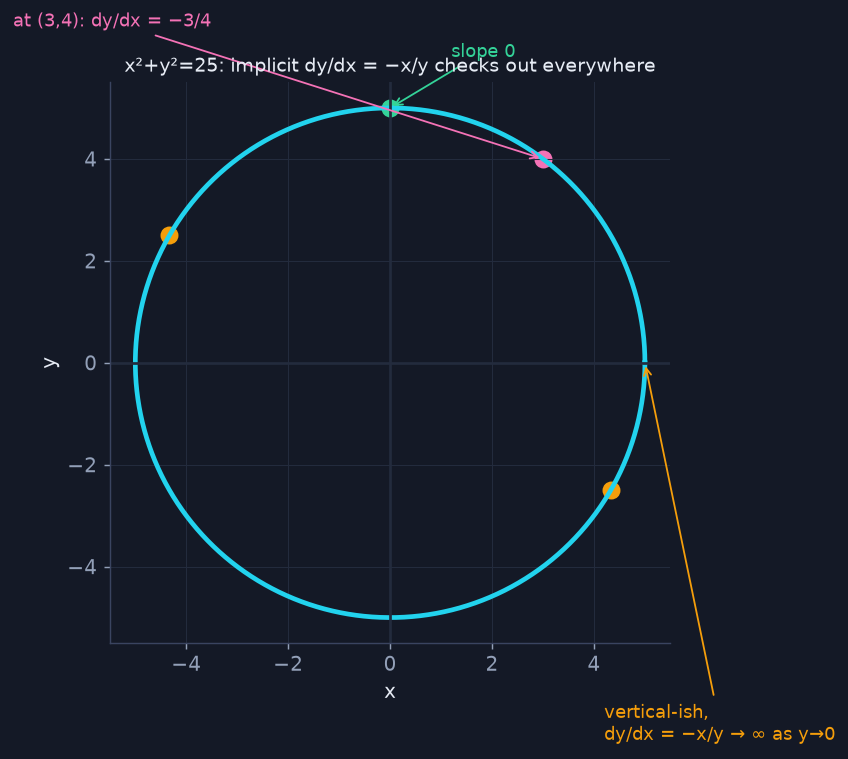
Worked: circle slope
\(x^2+y^2=25\). Find \(\frac{dy}{dx}\).
- \(\frac{d}{dx}(x^2)=2x\); \(\frac{d}{dx}(y^2)=2y\cdot\frac{dy}{dx}\) (y is an inside function — chain!); \(\frac{d}{dx}(25)=0\)
- \(2x+2y\dfrac{dy}{dx}=0\)
- \(\dfrac{dy}{dx}=-\dfrac{x}{y}\)
Sanity: at the top of the circle (0,5) slope = 0 ✓ (flat); at the side (5,0) it's vertical ✓. The formula knows the circle.
Worked: tangent via implicit
Find the tangent to \(x^2+xy+y^2=7\) at \((1,2)\).
- Differentiate: \(2x+y+xy'+2yy'=0\) (product rule on the xy term: \(1\cdot y+x\cdot y'\))
- Plug point: \(2+2+y'+4y'=0\) → \(4+5y'=0\) → \(y'=-4/5\)
- Tangent: \(y-2=-\frac45(x-1)\)
Mini-drill 11
a) \(\cos(x^2)\) derivative b) \(\dfrac{dy}{dx}\) if \(x^2+y^3=6xy\) (answer in terms of x,y) c) slope of \(y^2=x^3\) at (4,8)
Answers: a) \(-\sin(x^2)\cdot2x\) · b) \(2x+3y^2y'=6y+6xy'\) → \(y'(3y^2-6x)=6y-2x\) → \(y'=\frac{6y-2x}{3y^2-6x}\) · c) \(2yy'=3x^2\) → \(y'=\frac{3x^2}{2y}=\frac{48}{16}=3\)
12 · Exam Intel (from your Canvas — verified this morning)
- When/where: Oct 5/6, your regular lecture time & room. Write in YOUR registered section — wrong room risks a zero.
- Time: 70 minutes (not the full 80 — 10 min admin). 6 questions → budget ~11 min each; long-answer proofs deserve more, MC less.
- Format: 6 questions mixing short answer, long answer, — may include: calculations, applications, proofs, fill-in-blank, T/F with justification required, and multiple choice where 0 to 4 answers can be correct and each wrong selection costs −1 mark. Strategy: only select options you're confident in; an unsure checkmark is negative expected value.
- No formula sheet. Everything from section 13 below lives in your head now.
- Weight map: Chapter 2 (limits) ≫ heaviest emphasis; 3.1–3.3 medium; 1.1–1.5 light; 4.6 token.
- Practice-file correction (posted Oct 4): old midterm Q2(b) last bullet now reads "\(f(x)\) is continuous on its domain except at \(x=-2\), where it is not continuous." Use the corrected wording when practicing.
- Free practice: Mobius has unlimited-attempt practice quizzes for Ch 1 & 2 — fastest reps available before class.
13 · The Memorize Card (no sheet — this is the sheet, in your head)
Limits
Two-sided exists ⟺ sides equal.
Plugging in first, always.
\(\frac00\) → factor-cancel / conjugate.
\(\frac{c}{0}\) (c≠0) → DNE (VA).
Squeeze: trapped between agreeing walls.
Continuity at a (3 checks)
1. \(f(a)\) exists
2. \(\lim_{x\to a}f(x)\) exists
3. equal to each other
Types: removable / jump / infinite
ε–δ (words)
For every ε>0 there exists δ>0: if \(0\lt|x-a|\ltδ\) then \(|f(x)-L|\ltε\).
Linear proofs: δ = ε/|slope|.
Limits at ∞
deg top < deg bottom → 0
equal → leading-coef ratio
top wins → ±∞ (DNE)
\(\sqrt{x^2}=|x|\) — sign-aware!
IVT
Continuous on \([a,b]\), \(N\) between \(f(a),f(b)\) → ∃ \(c\in(a,b)\): \(f(c)=N\). Use \(N=0\) for root proofs.
Derivative definition
\(f'(x)=\lim_{h\to0}\frac{f(x+h)-f(x)}{h}\)
or \(f'(a)=\lim_{x\to a}\frac{f(x)-f(a)}{x-a}\)
Differentiable ⟹ continuous (one-way!).
Rules
Power: \(nx^{n-1}\) (all n!)
Product: \(f'g+fg'\)
Quotient: \(\frac{f'g-fg'}{g^2}\)
\((e^x)'=e^x\)
Trig (6)
\((\sin x)'=\cos x\) · \((\cos x)'=-\sin x\)
\((\tan x)'=\sec^2x\) · \((\cot x)'=-\csc^2x\)
\((\sec x)'=\sec x\tan x\) · \((\csc x)'=-\csc x\cot x\)
"co- means negative"
14 · Final Drill — 14 questions, exam-flavor (answers hidden)
ANSWERS — check honestly
Q1: factor: \(\frac{(x-3)(x+3)}{(x-3)(x+2)}=\frac{x+3}{x+2}\Big|_3=\frac65\) · Q2: conjugate → \(\frac{1}{\sqrt{1+x}+1}\to\frac12\) · Q3: tie at deg 3 → 6/3 = 2 · Q4: limit = \(\lim\frac{(x-4)(x+4)}{x-4}=8\) → k=8 · Q5: continuous (poly), f(0)=−1<0, f(1)=1+2−1=2>0, 0 between → IVT ∃ root ∈(0,1) ∎ · Q6: \(\frac{(x+h)^2-2(x+h)-x^2+2x}{h}=\frac{2xh+h^2-2h}{h}=2x-2+h → \boxed{2x-2}\) · Q7: f(3)=3, f'(3)=4 → y−3=4(x−3) → y=4x−9 · Q8: \(3x^2\sin x+x^3\cos x\) · Q9: domain x≠3; HA: tie → ratio 2/1 = 2; VA at x=3 · Q10: TRUE — differentiability forces continuity (the limit \(\frac{f(x)-f(a)}{x-a}\) existing requires \(f(x)\to f(a)\)) · Q11: FALSE — \(f(1)=0\) is irrelevant to the limit; limit = plug in = 0, exists fine · Q12: \(\frac{t^3}{t^2}=t\to\boxed{0}\) · Q13: \(x+2\sqrt{x}+1\) → \(1+\frac{1}{\sqrt{x}}\) · Q14: \(|3x-2-10|=3|x-4|\lt\varepsilon ⟸ |x-4|\lt\varepsilon/3\) → δ=ε/3 ∎
Morning-of checklist
- Correct lecture room, registered section, laptop if told to bring it
- 6 trig derivatives recited once out loud before walking in
- ε–δ in words once out loud
- MC discipline: −1 per wrong — don't lottery-guess
- Long answers: name the law/theorem you used — justification marks are explicit in this course
- 70 min / 6 questions — if Q5 is eating time, bank the MC marks first